


AcceleDent |
Preventive Treatment |
Types of Appliances |
Surgical Orthodontics |
Incognito |
Invisalign |
Damon Braces |
Wilckodontics
Types of Appliances
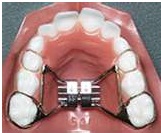 |
Rapid Maxillary ExpanderA Rapid Maxillary Expander (RME) is used for patients whose upper jaw is narrow. It gently widens the upper arch (palate) by stretching the central suture. Once widened, the suture knits together. Another person, most often a parent, adjusts the rapid maxillary expander daily as instructed for about 2-3 weeks, until the palate has been adequately widened. It is then left in place for six months without further adjustments so that new bone fills in and stabilizes the movement. |
 |
Quad Helix
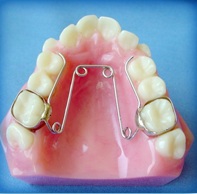
A Quad Helix is a fixed orthodontic appliance that is used to expand the upper arch. It is cemented in the mouth with bands on the back molars. The four helix springs help widen the arch to make room for crowded teeth or correct posterior crossbite. Good oral hygiene is a must while wearing the Quad Helix. Patients are asked to brush around and under the appliance and also floss and rinse thoroughly to remove any food particles. |
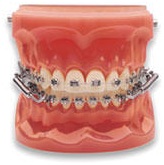 |
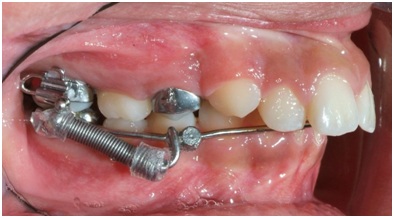
ForsusThe Forsus appliance is used to help move the upper molars back while moving the lower teeth forward. This appliance is composed of a spring coil rod, and is used while a patient is currently wearing braces. It runs from the upper first molar band down to the lower archwire. 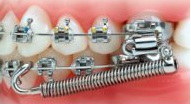 Patients will notice some discomfort initially, so we recommend a soft food diet for the first few days after the appliance is placed. Regular anti-inflammatory medication may help with any pain, if needed. It is important to keep the appliance clean; you may do this by carefully brushing the coil and other metal pieces of the appliance. If your Forsus appliance breaks, please contact our office to schedule a repair appointment. |
 |
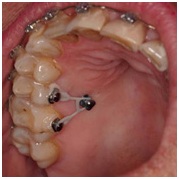
Crossbow ApplianceA Crossbow is an appliance that is used when the upper teeth are protruding forward of the lower teeth. This device is cemented into the patient's mouth and cannot be removed. The appliance consists of bands that are cemented to the upper and lower first permanent molar teeth. Special springs are positioned to connect the top and bottom parts of the appliance: these springs deliver gentle forces to both jaws and all the teeth, resulting in backward movement of the upper teeth and jaw, and forward movement of the lower teeth and jaw. These movements help to reduce the protrusion of the upper teeth and noticeably improve the bite and aesthetics of the child's face and smile. |
 |
Temporary Anchorage Devices (TAD's)Temporary anchorage devices (TAD's) are one of the many recent advances in orthodontics at our disposal for efficient tooth movement. TAD's are titanium miniscrews, just like dental implants, which can be anchored into the bone and can be used for moving teeth while keeping others still, or to achieve orthodontic movement in a mouth with missing teeth. Temporary anchorage devices may not be recommended for everyone, and in fact, anchorage devices at all may not be needed in all cases. Contact us if you'd like to know more about TADs. |
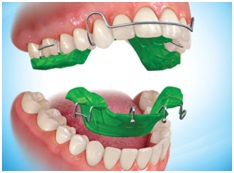 |
Twin BlockThe Twin Block functional appliance is designed to correct jaw positioning, so that the bite is properly aligned. The Twin Block consists of upper and lower removable appliance that has blocks that in order for the patient to close their mouth they must push their bottom jaw forward. This increases the strength of the lower jaw and teaches the lower jaw to close in the new position. Eating is very difficult at first, but comes with time. It is generally used during Phase 1 of orthodontic treatment, to treat children who have an underdeveloped lower jaw. To ensure treatment progresses as planned, the appliance should be worn at all times. It should only be removed for cleaning and during sport activities. Patients should follow instructions carefully to ensure effective results are achieved within the least amount of time. |
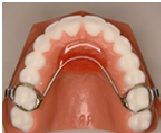 |
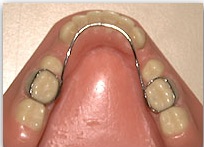
Nance Space MaintainerThe Nance Appliance is a Space Maintainer that is used to prevent the upper molars from moving forward while waiting for the permanent teeth to grow into place. The appliance is made of two bands that are cemented onto the first molars and a wire spans the roof of the mouth from one molar to the other. An acrylic pad or "button" covers the wire that touches the roof of your mouth directly behind your front teeth. Patients should always brush around the bands daily. Do not eat sticky, chewy candy as it can loosen your appliance. |
 |
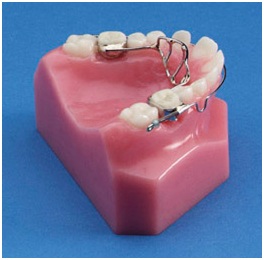
Lower Lingual ArchThe Lower Lingual Arch is designed to maintain the position of the lower molars as the baby teeth are lost and prevents them from drifting forward. This appliance is commonly used in cases of premature loss of baby teeth. By preventing the molars from moving forward, we can gain up to 5 mm of space to relieve crowding of the lower teeth. If this space gain is not utilized, it can often mean that permanent teeth must be extracted in order to alleviate the crowding of the lower teeth. The lower lingual holding arch is worn until all the permanent teeth have erupted. |
 |
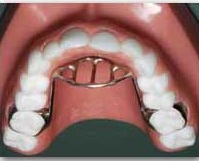
Thumb/Finger Habit ApplianceThumb sucking is a common habit among many children. It is associated with the need to seek food. In some infants it can signal fatigue, sleep, hunger, teething and shyness. Children usually cease thumb sucking when the permanent front teeth are ready to erupt. Typically, children stop between the ages of 2 and 4 years. Thumb sucking that persists beyond the eruption of primary teeth can cause improper growth of the mouth and misalignment of the teeth. If you notice prolonged and/or vigorous thumb sucking behaviour in your child, talk to your dentist. One solution to thumb sucking is placing an appliance behind the upper teeth on the roof of the mouth. The crib consists of semicircular stainless steel wires that are fastened to molars using steel bands. The crib usually stops the habit of thumb sucking within the first month of use. |
 |
Tongue Thrusting ApplianceFor patients that thrust their tongue in a forward position during swallowing or speaking, this appliance quickly redirects the tongue to a more normal position. If thrusting is constant, this can cause problems with teeth alignment and must be fixed. The appliance is glued in place and will usually stop the habit in the first couple of months. However, we will need to keep the appliance in place until the permanent front teeth overlap each other. |


 403.457.7700
 Springborough Professional Centre
30 Springborough Blvd SW, Suite 245
Calgary, AB T3H 0N9
Tel: 403.457.7700
Fax: 403.457.4300

30 Springborough Blvd SW, Suite 245
Calgary, AB T3H 0N9
Tel: 403.457.7700
Fax: 403.457.4300
Hours of Operation
Tuesday: 9:00 a.m. - 5:00 p.m.
Wednesday: 8:00 a.m. - 4:00 p.m.
Thursday: 7:30 a.m. - 4:00 p.m.
Monday: Admin Day
(8:00 a.m. - 2:00 p.m.)